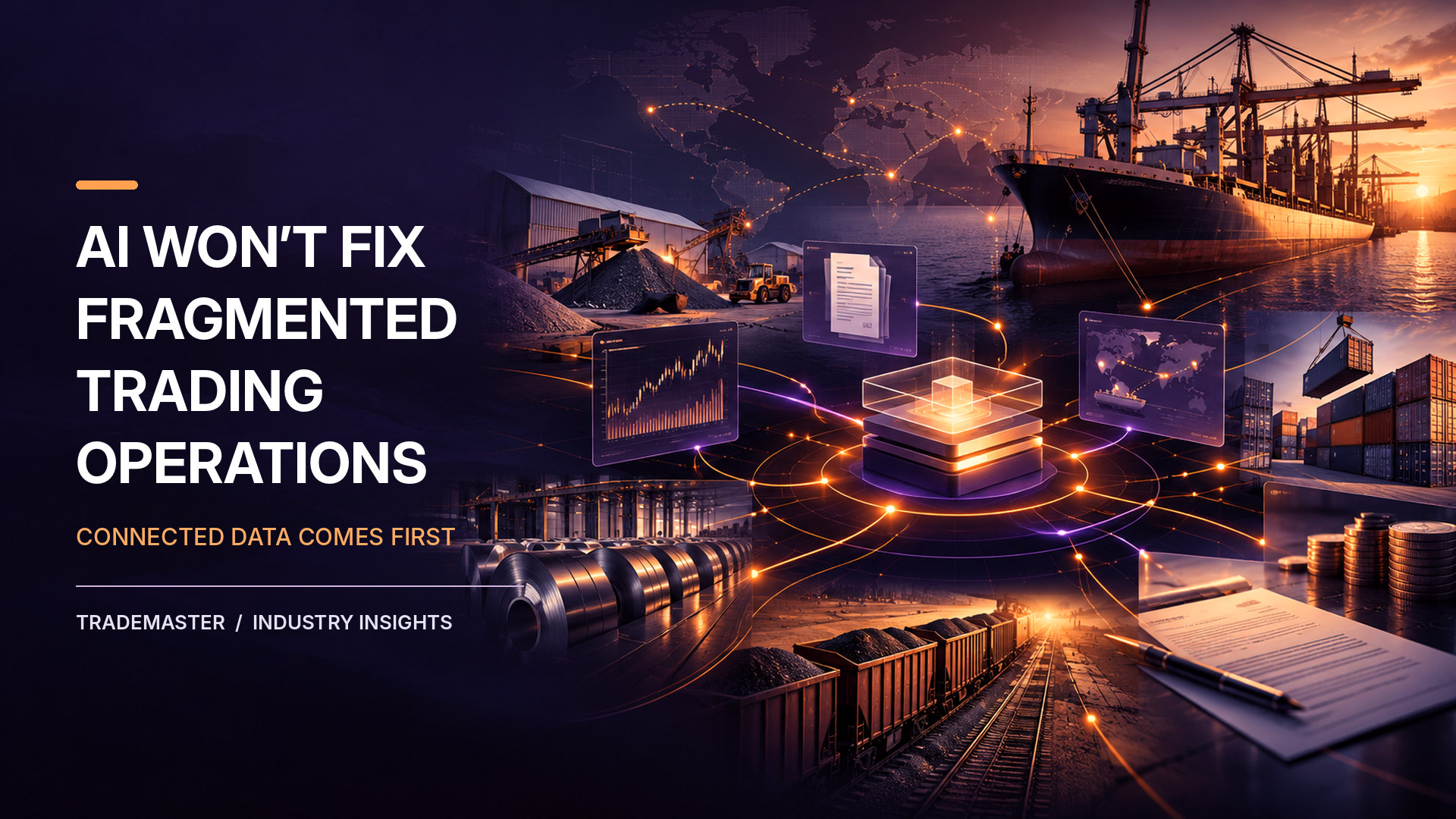
Why the future of Agentic AI in commodity trading depends on something far more fundamental than automation.
Artificial intelligence is rapidly becoming one of the most discussed technologies in commodity trading.
Vendors are introducing intelligent agents. Industry conferences are showcasing autonomous workflows. Trading firms are exploring how AI could transform everything from trade capture to settlement.
But amid this excitement, an important question is being overlooked:
What happens when we introduce sophisticated AI into trading operations that still depend on spreadsheets, disconnected systems, and fragmented information?
AI may make individual tasks faster, but it cannot automatically resolve inconsistencies between disconnected business processes.
For many commodity trading firms, particularly mid-sized physical trading houses, the immediate challenge is not a lack of artificial intelligence.
It is a lack of reliable, connected information across the trade lifecycle.
And that is where the conversation about Agentic AI should begin.
The Real Problem Isn’t Intelligence. It’s Fragmentation.
Consider how a typical physical commodity trade moves through an organisation.
A trader negotiates a deal with a supplier. Commercial terms are recorded in a contract or spreadsheet. The operations team coordinates the shipment, while finance manages invoices, payments, and cash-flow expectations.
Risk managers need visibility into market exposure, price movements, and the financial consequences of operational changes.
Each department may have the information it needs, but that information is not necessarily connected.
A shipment quantity changes, but the expected trade margin is not immediately updated.
Additional freight or handling costs are recorded separately.
Finance may discover changes affecting settlement amounts only after receiving revised documents.
Teams spend time reconciling multiple versions of the same transaction.
These are not simply administrative inconveniences.
Disconnected information creates operational friction and can increase commercial risk, especially when shipment changes affect margins, exposures, and payment obligations.
At APPEC 2026, industry speakers highlighted the continued reliance of physical commodity trading on emails, spreadsheets, and manual handoffs. Reporting by S&P Global identified these fragmented processes as sources of operational risk and delayed reconciliation.
The fundamental question for trading firms is therefore straightforward:
Can you reliably follow a trade from its initial agreement through physical execution, settlement, and cash flow?
If the answer is no, introducing another intelligent application may add complexity instead of removing it.
What Agentic AI Actually Changes
Traditional automation follows predefined rules.
An invoice matches an approved transaction. A confirmation satisfies established tolerances. A report runs according to a scheduled procedure.
Agentic AI introduces a different approach.
AI agents can interpret unstructured information, coordinate tasks across applications, identify exceptions, and suggest actions based on changing circumstances.
In commodity trading, several applications are particularly relevant.
Trade capture and confirmation
AI agents can extract commercial terms from emails, contracts, and other documents, helping transform unstructured communications into structured records for validation.
Logistics and scheduling
Intelligent workflows can monitor shipment communications, identify changes in vessel schedules or delivery arrangements, and alert relevant teams.
Document processing
Contracts, bills of lading, commercial invoices, and inspection documents can be compared against recorded trade information to identify potential inconsistencies.
Settlement and financial operations
AI-supported processes can assist with reconciliation, payment tracking, and identifying differences between agreed terms and actual execution.
These capabilities are moving beyond conceptual discussion.
At Commodity Trading Week Europe 2026, DycoTrade and Publicis Sapient demonstrated agent-based use cases involving vessel updates, supplier communications, inventory visibility, and business insights.
ClearOpx also introduced an Operations Trade Risk Management (OTRM) platform designed to coordinate operational workflows alongside existing CTRM and ETRM systems.
These developments illustrate growing interest in intelligent workflow automation.
However, vendor demonstrations and announcements are not proof that every capability is mature or widely deployed in production.
The real test is not whether AI can perform a task. It is whether it can perform that task reliably, securely, and consistently within a live trading operation.
One Shipment, Multiple Financial Consequences
Consider an illustrative example.
A commodity trading company purchases recyclable material from Saudi Arabia and sells it to a buyer in India.
The trader agrees on quantity, price, quality specifications, delivery terms, and payment conditions.
The operations team then coordinates loading, inspection, shipping, and documentation.
Now imagine the actual loaded quantity differs from the quantity originally agreed.
That single change could affect the final invoice amounts, depending on the contract terms. It could also influence freight or handling costs, the expected trade margin, and settlement or cash-flow projections.
In a fragmented environment, updating these details may require several departments to exchange emails, amend spreadsheets, and reconcile conflicting records.
A connected CTRM environment provides a more dependable foundation.
Commercial, logistical, and financial information can be maintained within linked processes, helping teams understand the consequences of operational changes without manually reconstructing the transaction.
Now consider what Agentic AI could add.
An appropriately integrated AI agent might read an updated loading report, identify the quantity difference, retrieve the related trade information, and suggest which records need attention.
It might also flag a potential impact on settlement or expected profitability.
But one distinction is essential:
The agent should not invent missing trade information or independently approve material commercial changes.
Its role should be to make relevant information accessible and actionable while preserving appropriate human oversight.
Without reliable trade records, even sophisticated AI can produce incomplete or misleading recommendations.
Why Connected CTRM Systems Remain Essential
The emergence of Agentic AI does not make Commodity Trade and Risk Management systems obsolete.
It makes their underlying role more important.
A CTRM platform provides the structured foundation for managing transactions, positions, physical movements, financial obligations, and operational records.
These processes establish the information needed for reliable analysis and decision support.
Emerging AI-enabled operational layers can complement this foundation by interpreting incoming information and supporting activities across different applications.
But transaction control and intelligent automation serve different purposes.
The CTRM maintains the integrity of the trading records. AI can help professionals work with that information more efficiently.
This distinction matters particularly for mid-sized physical commodity trading firms.
Their challenge is often not a shortage of sophisticated technology, but the difficulty of coordinating commercial and operational information without unnecessary manual effort.
Before investing in complex autonomous workflows, they may obtain more immediate value by connecting trade capture, logistics, risk, settlement, and cash-flow information.
The objective should not be greater technological complexity.
It should be simpler operations, stronger visibility, and better commercial decision-making.
Governance Is the Difference Between an AI Demo and a Reliable System
Commodity trading decisions have financial consequences.
Incorrect quantities, outdated prices, mismatched contract terms, or inaccurate settlement calculations can affect profitability and risk exposure.
For that reason, adopting AI requires clear operational controls.
Data security: Sensitive commercial information must remain protected through appropriate permissions and security measures.
Information reliability: AI-generated outputs should be validated against dependable records and clearly identify uncertainty.
Human oversight: Material transactions, approvals, and exceptions should remain subject to defined decision-making responsibilities.
Auditability: Organisations should be able to trace the information used, actions recommended, and decisions executed.
These are not secondary technical requirements.
They determine whether AI can be trusted within production trading environments.
The objective is not to remove human judgment from commodity trading. It is to give professionals better information, reduce repetitive work, and support more informed decisions.
Connected Operations Before Autonomous Operations
The next phase of commodity trading technology will likely involve closer integration between transaction management, operational workflows, financial information, and AI-assisted decision-making.
But successful adoption should not be measured by the number of AI agents a company deploys.
It should be measured by practical business outcomes.
Can traders see their positions and expected margins without collecting information from several systems?
Can operations teams identify changes that affect commercial performance?
Can finance teams access timely information about costs, settlements, and expected cash flow?
Can managers understand the information behind an AI-generated recommendation?
And can repetitive processes be reduced without weakening governance?
These questions should guide technology investment.
For mid-sized trading houses, achieving a clear and reliable view of the trade lifecycle may be more immediately valuable than adding autonomous capabilities to an already fragmented environment.
Agentic AI has meaningful potential in document processing, exception management, operational coordination, and information retrieval.
However, its greatest value will come when intelligent automation builds on dependable data and connected business processes.
Conclusion: Start With the Foundation, Not the Hype
Agentic AI represents an important development in commodity trading technology.
Early applications demonstrate how intelligent systems can help process information, reduce repetitive tasks, and improve coordination across trading operations.
But AI alone cannot resolve disconnected workflows, inconsistent records, or unclear responsibilities.
The firms best positioned to benefit will be those that establish dependable trading information, connect commercial and operational processes, and maintain visibility across the financial lifecycle of their transactions.
At TradeMaster, we believe the path towards smarter commodity trading begins with a practical foundation: connecting physical trades, logistics, risk, settlement, and cash-flow information.
Our focus is on reducing unnecessary manual work, improving operational visibility, and helping trading professionals make decisions with greater clarity.
Because before a trading company can benefit fully from intelligent automation, it must first be able to trust the information that intelligence depends on.
The future of commodity trading is not simply about making software more intelligent. It is about making the entire trading operation work more intelligently.
Let’s Continue the Conversation
For physical commodity trading firms, where does the greatest operational friction exist today?
Is it trade capture, logistics coordination, documentation, settlement, or maintaining an accurate view of positions and cash flow?
We’d welcome your perspective.
If your organisation is exploring ways to connect trading workflows and reduce manual processes, learn more about our approach at TradeMaster.
Industry References
S&P Global Energy — September 2026
Energy Industry Moving from AI Experimentation to Operational Deployment
Commodity Technology Advisory / CTRM Center — October 2026
AI in Commodity Risk Management: Getting the Data Right Comes First
DycoTrade — 2026
Unlocking Agentic Intelligence: A New Chapter in CTRM
ClearOpx — May 2026
Transforming Operations into a Driver of Risk and Revenue Management